As you might know, I don't review every band I see live; instead, I generally try to review the ones which are a bit different - the shows where the bands involved manage to make it really feel like something noteworthy and special. As soon as I knew that Dragged into Sunlight would be playing Glasgow, based on how they sounded, their aesthetic, and the tales I'd been told about their truly malign stage show, I suspected that they would be the kind of live experience which would be worth writing down, and I can safely say I wasn't disappointed.
The Audio in Glasgow is quite an interesting venue; very small, compact, and minimalistic, but at the same time, really well equipped in terms of lighting, smoke-machines, and very reasonable sound-mixing indeed, something which the generally knackered aesthetic of the venue itself might not suggest; in other words, it's the sort of venue where you probably shouldn't bother to lock the toilet cubicle, because if someone tries to get in, the whole thing will just fold up and collapse anyway. As the evening went on, the place was full enough to be packed, but not full enough to be ridiculous, which felt like a nice balance; certainly, there was enough space to check out the merch tables, where Dragged into Sunlight were selling all kinds of alarming weaponry; more like a satanic bizarre than a merch table at a gig; namely bongs and T-shirts which even your friends might be a bit offended by. Bossk have an interesting assortment of things too; apparently including soap.
First on were Headless Kross, a local sludgy-doom outfit who I've seen a couple of times before. The signature the band possess tends to be their ability to bend around the normal constraints of time and space, making a thirty minute set feel like an hour. This night, in addition to doing just that, they were on top-form. The sound-mixing gods had smiled on them a lot, and the set was tight, with a splendidly creamy, straight-to-the-face tone, causing all of the instruments to blend into a splendid, rafter-reverberating doomy display. The vocals, particularly, came through more clearly then usual, and had an interesting echoey, almost ethereal effect on them, which they seemed to share with the next band. Perhaps Headless Kross are an acquired taste, perhaps they've been on a steady slope of becoming tighter and more enjoyable to listen to, or perhaps both; whatever the case is, I enjoyed their set more than ever before this time around, and the rest of the audience seemed to share their enthusiasm. I think the promoters decision to host mainly doom-metal opening acts was a wise one; it was a very refreshing affair indeed not to be swamped with the usual modern death-metal acts which Glasgow has to offer. Granted, some of them are great, but everyone needs a rest once in a while.
Sunsmasher are also local, although all I really know about them is that they apparently used to play more slowly than they do now. It's probably just as well that Headless Kross rattled the building for a while to warm it up, otherwise Sunsmasher's tone might well have made it fall down. To my ears, Sunsmasher go down a similar road to Headless Kross, albeit catering more to the extremes; the tone was less friendly and more crunchy; the sort of tone that when the first chord is struck, you look at the person next to you and make your very best "fucking-hell" face, as your hair waves around at the whim of the sound-waves passing your head. It's probably just as well that I had a chance to practice my "fucking-hell" face before Dragged into Sunlight came on. Ultimately, whilst I'm not too familiar with Sunsmasher's material, I found their set very enjoyable indeed, a second helping of dark, doom-laden goodness for the evening, perhaps a little darker than Headless Kross, but nothing like as dark as what was to come.
Bossk are one of those metallic post-rock sort of outfits, once again, a band I'm not too familiar with. As an exception to the evenings dark feel, Bossk tended towards being very serene, floaty and at times very beautiful. The juxtaposition between the sections which are instrumental and the sections which have a vocalist is a bit jarring, and I must confess that I strongly preferred the latter; to each their own, of course. Bossk have an interesting stage presence, particularly in light of the peace which their music tends to have; it's not so much a "look at us" vibe, but a far more honest "listen to this" one. Most of the set was very tranquil; the kind of music which you can sway back and forward too, or it would have been, if I didn't keep bumping into people while trying to do so. The rest was punctuated by relatively heavy, bouncy passages which were sort of doomy, but at the same time exuded a rock edge which felt overtly non-metal. Perhaps if, in you're vocabulary, "non-metal" is synonymous with "non-good", I can safely say that this isn't the case; Bossk seemed excellent and fascinating to listen to, indeed, I can certainly see why the band are favour of the month just now. Generally, the crowd seemed very enraptured by the show; divided into three groups - people who had heard of Bossk, people who hadn't, but were enjoying it, and that guy, who knew every single one of their tracks inside out, and was very vocal of his approval. If I'd known any of their songs at all, I'd probably have felt the same.
There is a form of epilepsy which you can have which eventually goes away. I used to have it, but I certainly don't any more. How do I know it's gone away? Because I stood through Dragged Into Sunlight's set and am not dead. I've never seen a band quite so intent on murder-by-strobe light. Everything about the band's set is intense, beginning even before they properly take to the stage. Slowly, candles are lit, one by one. A deer skull is mounted on the stage-left, and then a second on the right. A friend looks at it and remarks "this is going to be silly, isn't it?" The "frontman" - a candelabra with a rams skull mounted on it, and the only thing which will face the audience for any length of time, is placed in centre stage. Then the lights go out, leaving nothing but the glow of the candles. In my head, undertakers theme chimes for a moment, and then the joke fades away.
Like the bands studio material, a malign, dark spoken word sample ushers the beginning of the bands set, before the band bursts into their material, with their backs to the crowd almost constantly; like a black mass. The murky sound of the bands studio work is very faithfully and effectively reproduced in a live setting, and the whole set sounds great; the murky churning, the darkness, the suspense filled sections - all are extremely well deployed, amid sick, satanic red lighting, and ferocious, almost constant strobe lighting, which obscures the band further from view, even then the vocalist is facing the front. I couldn't even count how many of them there were, and I think that's a great manoeuvre by the band; the mystique and darkness of the affair is greatly reinforced by it, and I think it's the best coming together of stage-show and music that I've seen in a long time; perhaps ever. Dragged into Sunlight make an effort, and it pays off. Amid the strobe lighting, the whole crowd's attention is grasped, with no hope of escape; at one point there's a pit, but I didn't manage to notice, because I was too busy clinging to the bar for my life, and nodding my head in awe - across from me, the bar-woman looks miserable, hunched on a chair, perhaps hoping that all of these moshers will leave so she can go home; certainly, Dragged into Sunlight is harrowing for the people that want to be there, let alone unwilling bar-staff.
Ultimately, the band played quite a short set, perhaps thirty-five minutes, but it felt like enough; not too short, not too long. Afterwards, you have a feeling of relief, the feeling of having survived some terrible incident, barely. But I also felt the impact of having been to a damn good show. Dragged into Sunlight are, and I don't exaggerate, one of the best live bands I've seen in a long time... and you barely even see them. It's uncomfortable, intense, and punishing, but at the same time, it's very, very good.
Links:
Dragged into Sunlight Official Site
Dragged into Sunlight on Facebook
Dragged into Sunlight on Metal Archives
Bossk Official Site
Bossk on Facebook
Bossk on Metal Archives
Sunsmasher on Facebook
Sunsmasher on Metal Archives
Headless Kross on Facebook
Headless Kross on Metal Archives
Wednesday, 29 May 2013
Sunday, 26 May 2013
#278 Darkthrone - The Underground Resistance
As I mentioned at the time, the reason I didn't include The Underground Resistance in the Darkthrone marathon of a few days ago is on account of how new it is, I felt I should write a review of it in-full. When the album originally came out, some months ago, things kept getting in the way of me reviewing this album. Fortunately, the side-effect of this is that I've now had a lot of time to listen to it properly, and hopefully make a few observations about it which I might have missed in reviewing it a few days after I got it.
As a record, The Underground Resistance is a bit of a microcosm for the band's career as a whole; it varies a lot, but all carries within it the essence of Darkthrone, through and through. Once again, the record is different to it's predecessor, but carries on certain parts and styles; in this case, the traditional heavy metal elements of Circle The Wagons are turned up to eleven, and further squish out the punk and black-metal parts, which, whilst both present in trace amounts still, are really taking back-stage compared to the riff-tastic speed-metal. The guitar tone is warm and chunky, and the riffs are quirky and angular, coiling more tightly than the work on the previous three or four records, and cruising along with a degree of brooding majesty, creating an extremely catchy record, especially the winding, idiosyncratic work on songs like "Come Warfare, The Entire Doom". In fact, the riffs in general bring with them a pretty hefty thud and crunch, with a richer sound than the band have conjured in a long time; the lower-end, for instance, is more earthy than anything since Soulside Journey; crisp, clear and fluid, while retaining the trademark Darkthrone rough-edges. The drumming too, feels like a real showcase of just what Fenriz can do when he gets behind the drums, and the production really captures a percussive, but not overly clean sound. Of course, if anyone knows how to make a record sound overtly old-school, it's probably Fenriz and company, and it comes as absolutely no surprise to me that the band have succeeded with this one; the production and actual substance of the record go hand in hand very well indeed.
One of the things most obviously amplified since Circle the Wagons has been the clean vocal approach, and a good number of the tracks on the record have Fenriz really giving it his all with regards to clean vocals, of the kind of quality they were in his best moments with Isengard. Tracks like Valkyrie really take Darkthrone into a deliberately epic and grandiose place which they haven't explored in quite the same way before, and I can safely say it's one of my favourite tracks on the record, a record which, incidentally, doesn't have much in the way of filler. It's quite hard to have any filler when it's only six tracks in length, but fortunately, I think it's safe to say that there isn't really a weak link among them. I had initial misgivings about Leave No Cross Unturned; the fourteen minute behemoth of a closing track, that it might be a bit longer than it's content should really justify; but after a few listens, it's length suddenly doesn't become an issue, which is really the best way to approach the record. A single listen doesn't quite work, and neither do a few; you've got to really get to know it to appreciate some of it's intricacies and it's overarching character, but when you spend some time with it, it's really potential to be enjoyable is unlocked. It probably says a lot about the bands influences that Manilla Road are similar in this regard; you can't listen to a Manilla Road album once and get it.
So there we go - the culmination of about a week and a half of me reviewing nothing but Darkthrone. The Underground Resistance has certainly been one of my favourite records so far this year, and once again, as they do on almost every record, Darkthrone have managed to capture the spirit of people making music because it's what they love to do, and what's more, making the kind of music which they love.
This is certainly an 8/10.
Links:
Darkthrone Official Site
Darkthrone on Facebook
Darkthrone on Metal Archives
Be sure to check back soon for the next review, which won't be Darkthrone, but might be dark.
As a record, The Underground Resistance is a bit of a microcosm for the band's career as a whole; it varies a lot, but all carries within it the essence of Darkthrone, through and through. Once again, the record is different to it's predecessor, but carries on certain parts and styles; in this case, the traditional heavy metal elements of Circle The Wagons are turned up to eleven, and further squish out the punk and black-metal parts, which, whilst both present in trace amounts still, are really taking back-stage compared to the riff-tastic speed-metal. The guitar tone is warm and chunky, and the riffs are quirky and angular, coiling more tightly than the work on the previous three or four records, and cruising along with a degree of brooding majesty, creating an extremely catchy record, especially the winding, idiosyncratic work on songs like "Come Warfare, The Entire Doom". In fact, the riffs in general bring with them a pretty hefty thud and crunch, with a richer sound than the band have conjured in a long time; the lower-end, for instance, is more earthy than anything since Soulside Journey; crisp, clear and fluid, while retaining the trademark Darkthrone rough-edges. The drumming too, feels like a real showcase of just what Fenriz can do when he gets behind the drums, and the production really captures a percussive, but not overly clean sound. Of course, if anyone knows how to make a record sound overtly old-school, it's probably Fenriz and company, and it comes as absolutely no surprise to me that the band have succeeded with this one; the production and actual substance of the record go hand in hand very well indeed.
One of the things most obviously amplified since Circle the Wagons has been the clean vocal approach, and a good number of the tracks on the record have Fenriz really giving it his all with regards to clean vocals, of the kind of quality they were in his best moments with Isengard. Tracks like Valkyrie really take Darkthrone into a deliberately epic and grandiose place which they haven't explored in quite the same way before, and I can safely say it's one of my favourite tracks on the record, a record which, incidentally, doesn't have much in the way of filler. It's quite hard to have any filler when it's only six tracks in length, but fortunately, I think it's safe to say that there isn't really a weak link among them. I had initial misgivings about Leave No Cross Unturned; the fourteen minute behemoth of a closing track, that it might be a bit longer than it's content should really justify; but after a few listens, it's length suddenly doesn't become an issue, which is really the best way to approach the record. A single listen doesn't quite work, and neither do a few; you've got to really get to know it to appreciate some of it's intricacies and it's overarching character, but when you spend some time with it, it's really potential to be enjoyable is unlocked. It probably says a lot about the bands influences that Manilla Road are similar in this regard; you can't listen to a Manilla Road album once and get it.
So there we go - the culmination of about a week and a half of me reviewing nothing but Darkthrone. The Underground Resistance has certainly been one of my favourite records so far this year, and once again, as they do on almost every record, Darkthrone have managed to capture the spirit of people making music because it's what they love to do, and what's more, making the kind of music which they love.
This is certainly an 8/10.
Links:
Darkthrone Official Site
Darkthrone on Facebook
Darkthrone on Metal Archives
Be sure to check back soon for the next review, which won't be Darkthrone, but might be dark.
Thursday, 23 May 2013
Metal Marathons #001 Part 2: Darkthrone: The Revenge
part two of two.
Welcome back, ladies and gentlemen, to the marathon retrospective of Darkthrone's career; last time we had travelled from the abyss of rumbling, complex death metal, through the vast, icy forests of classic and much-loved black metal, and out the other side into the primitive, chord driven, and some would say re-hashed landscape of the band's middle years. This time around, we are going to travel through that place, and out the other side into a slow cascade of old-school influences and Manilla Road, wherein the band resides now.
Of course, the majority of this marathon will be aimed at the "punk" albums which started with "The Cult is Alive" - something of a paradigm shift, if you will, in the bands sound; and certainly one of the most fundamental ways to divide the "old" and "new" sound the band had. First, however, there remain three of the much-overlooked middle-era black metal albums to plough through starting with Plaguewielder. In my experience, there tends to be more to these records than meets the eye, and I'll be first to claim that listening to them is utterly worthwhile. I urge you to.
As I said in part one of this marathon, Ravishing Grimness cannot be dismissed as "more of the same". Plaguewielder, however, might be. The album is another forty-minutes or so of swaggering, relatively simplistic, chord driven black-metal. Not unpleasent, by any stretch; in fact, I enjoy listening to the record, however, it feels less inspired than, say, most of the bands other material. I'll argue vehemently that the band have never had a truly "bad" album, and there are some flavoursome riffs scattered through this record To its credit, it manages to sound cold and grim in a time when a lot of black metal had ceased to.
Hate Them is an interesting one - it feels a step up in terms of song-writing and especially energy, with high-speed drumming and higher tempos all over the shop. By the band's own admission, Hate Them is the album in which they really started to delve into punk and other old-school influences more fully, and you can tell; many of the tracks take on a black n' roll edge, with d-beats, metal-punk style riffs, and other barrels of fun added to the recipe. The appeal to outside influences really gives the album a novel edge, and makes it very listenable; particularly tracks such as Divided We Stand, which could easily find a place on the later, less black-metal records.
Sardonic Wrath is, I suppose, the last "black metal" album the band ever did. Certainly, it feels like their final attempt to make an album which was black metal to the core. Ultimately, I really enjoy the record, and find it a fitting end to that part of the band's career; it's very raw; rough as a badger, in fact, and in the same way as Hate Them, combines elements of other genres nicely, but without spoiling the entirely black-metal bend of the record. You could slot Sardonic Wrath somewhere in between Transilvanian Hunger and Panzerfaust and nobody would be the wiser to the fact that it was actually made in 2004, a testimony to the fact that the band can still conjure great black metal, when they want to.
Whenever I go a while without listening to The Cult is Alive, it's always a bit more black-metal influenced than I remember; in fact, it's still quite raw and harsh, more a large-step along from Sardonic Wrath than an utter shift. The crucial difference however, is that from this record onwards, the band feel much more overtly fun. The bouncy riffs, influenced by traditional metal, crust punk, and a vast array of other things manage to be extremely catchy, ballsy and filled to the brim with sheer old-school attitude. This album marks a very profound reinvigoration of the band, as foreshadowed by the leanings towards this sound on the previous two records, on this one they come to power-chord based fruition.
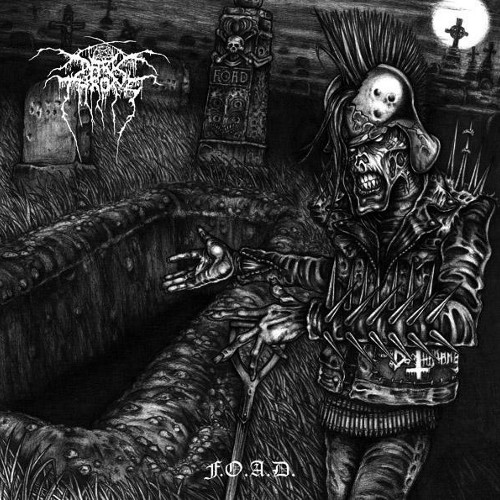
Once again stripping back the black-metal, FOAD is another foray into the old-school world of punk and speed-metal. It's sometimes easy to forget how different the more recent Darkthrone albums are from one another, and the gulf between The Cult is Alive and this record is very illustrative of it - gone is the harsh and scathing guitar tone, replaced with a more rock n' roll, warm sound which suits the less serious, more playful character of this record, and those beyond it. Lyrically too, this album makes forays further and further into more human themes, reducing the occult and Satan as themes, in lieu of tracks about metal and rock itself - a pronounced manoeuvre towards the world of vicariously recreating 1984.
Dark Thrones and Black Flags marked the beginning of a move towards more traditional old-school metal; it retains something of the punk and black-metal influence, of course, but at the same time, is a more clear, almost epic record in places. Clean vocals appear here and there, for instance in "The Winds They Called the Dungeon Shaker", very much foreshadowing the directions which the band would be going in the next record. The riffs on this record are among the most chunky in the "new Darkthrone" era, with a lot of bite and an enjoyably occult feel; the music is liable to be dark still, but in a more traditional way; often a spooky darkness, not the misanthropy of black-metal.
Circle the Wagons travels even further into the realm of pure heavy-metal, but, as with every other album manages to feel extremely Darkthrone still, which is a point worth raising; despite the bands vast number of changes in style and production, there has never been a Darkthrone album which didn't feel like one. Like it's predecessor, Circle the Wagons is an album filled with very tasty, hefty riff work, albeit frequently even more melodic. For me, at least, Circle the Wagons stands very prominently as a testimony to how radically Darkthrone's sound has changed, miles upon miles away from Soulside Journey or Transilvanian Hunger, and personally, I wouldn't have it any other way.
Ultimately, listening to all of a bands records in a row is a superb way to chart the changes in the bands sound, and it definitely equips you with new tools and ways in which to listen to the music; you become much more aware of the bands evolution and progression between styles and influences. If there's one thing which Darkthrone's discography has screamed at me, it's integrity. I don't think there's a single record by the band in which they weren't trying, and in the majority of them, they succeeded.
There are few bands so consistent and yet diverse in their discography; every album is a little different, but every album is utterly, unapologetically Darkthrone. That's why we like it, and obviously, that's how they like it too. Darkthrone unapologetically do what they will, and they do it well.
Links:
Darkthrone Official Site
Darkthrone on Facebook
Darkthrone on Metal Archives
But wait! you shout. What about the new Darkthrone record; "The Underground Resistance". Don't worry, I haven't forgotten it, I just think on account of being new, it deserves a full-length review, which I'll be doing in the next few days. Stay tuned!
Subscribe to:
Posts (Atom)